Offline Activation Games: 25 Crowd-Pulling Ideas With Setup, Prizes, and KPIs
If your booth feels invisible, it’s not because your brand is weak. It’s because the event environment is loud, busy, and full of distractions. People don’t stop for “information.” They stop for moments.
That’s why offline activation games work. They create:
- a reason to pause
- a low-effort way to participate
- a small reward
- a story worth sharing
This blog gives you a complete playbook: how to pick the right game, a library of 25 proven ideas, setup checklists, prize logic, and a measurement system so your activation isn’t just fun. It’s measurable.
The best offline activation games share five traits:
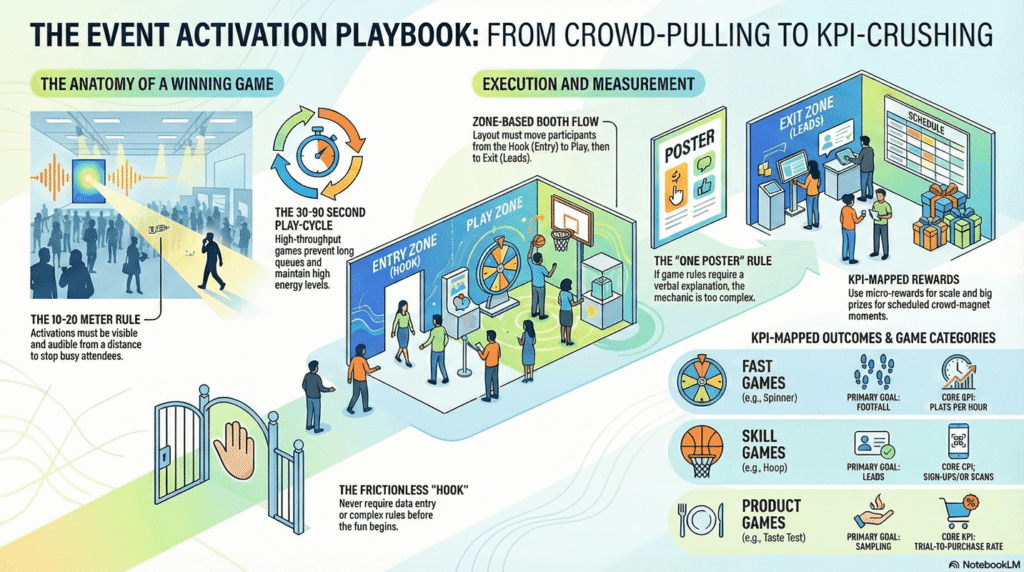
- They’re visible from 10–20 meters away.
- They take 30–90 seconds per participant.
- The rules fit on one poster.
- The prize is instant and fair.
- The game maps to a KPI: footfall, leads, sales, sampling, app installs, or UGC.
What are offline activation games?
Offline activation games are interactive, on-ground experiences designed to increase:
- foot traffic
- engagement time
- lead capture
- sampling or trials
- sales conversion
- social sharing
A game is different from a passive activity because it has:
- a challenge or mechanic
- a clear start and finish
- a reward or recognition
How to choose the right game (goal-first)
Before you pick a game, decide on the primary goal.
- If you want maximum footfall, choose fast, high-throughput games.
- If you want leads, choose a game that naturally ends with a QR scan or form.
- If you want sales, choose discount-based games tied to purchase.
- If you want sampling, choose taste-test or trial-based games.
- If you want UGC, choose photo challenges, leaderboards, and share prompts.
A simple selection matrix
Use this quick decision grid:
- Small space + low budget: spinner, quiz, scratch card, cup toss
- Medium space + medium budget: reaction game, mini hoop, stacking challenge
- Big space + high footfall: treasure hunt, relay games, team battles
- Family audience: wheel, toss, photo booth, stamp hunt
- Youth/campus audience: reaction, leaderboard challenges, rapid trivia, UGC games
The activation game design formula (works for any brand)
Use this structure when building or tweaking any game.
- Hook: What makes people stop? (sound, crowd, bright signage, scoreboard)
- Play: minimal friction (no long form before play)
- Reward: instant (sample, coupon, merch)
- Share: a photo moment or leaderboard
- Measure: a QR code, unique coupon, tally sheet, or scan-to-play
Read More: UndergrowthGames Contributor
Offline Activation Games Library (25 ideas)
Each idea below includes:
- Best for (goal)
- Time per participant
- Setup and materials
- KPI to track
A. Fast games (30–60 seconds, high volume)
1. Spin-the-Wheel (with brand questions)
- Best for: footfall + light education
- Time: 30–45 seconds
- Setup: wheel, simple question cards, prize buckets
- KPI: plays/hour, prize redemption rate
2. Dice Roll Discount
- Best for: sales conversion
- Time: 20–40 seconds
- Setup: oversized dice, discount chart, coupon codes
- KPI: purchase conversion rate, average order value
3. Lucky Draw (QR verified)
- Best for: leads + crowd pull
- Time: 30–60 seconds
- Setup: entry slips via QR, draw box, instant prizes
- KPI: leads collected, lead-to-sale follow-up rate
4. Cup Toss
- Best for: footfall + fun
- Time: 30–45 seconds
- Setup: cups, ping pong balls, branded table wrap
- KPI: participation count, dwell time
5. Ring Toss (product props)
- Best for: product awareness
- Time: 30–60 seconds
- Setup: rings, bottles/props, score rules
- KPI: plays, product demo requests after game
6. Rapid-Fire Quiz (10 seconds per question)
- Best for: education + lead capture
- Time: 45–60 seconds
- Setup: quiz cards, buzzer, leaderboard board
- KPI: correct answers, QR scans after quiz
7. “Pick a Card” Instant Win
- Best for: footfall + leads
- Time: 30 seconds
- Setup: mystery cards, prize mapping, QR sign-up to reveal
- KPI: sign-up rate, cost per lead
B. Skill and challenge games (60–120 seconds)
8. Reaction Time Buzzer Challenge
- Best for: crowds + excitement
- Time: 60 seconds
- Setup: buzzer light game or simple reaction device
- KPI: queue length, plays/hour, UGC shares
9. Mini Basketball Hoop
- Best for: mass engagement
- Time: 60–90 seconds
- Setup: hoop stand, soft balls, score chart
- KPI: plays, conversion to booth visit
10. “Beat the Clock” Stacking Challenge
- Best for: youth + corporate events
- Time: 60 seconds
- Setup: cups/blocks, timer, rules poster
- KPI: completions, repeat attempts, lead sign-ups
11. Puzzle Speed Run (brand image puzzle)
- Best for: recall and memory
- Time: 90–120 seconds
- Setup: branded puzzle pieces, timer
- KPI: completions, photo shares with finished puzzle
12. Balance Challenge (hold a pose)
- Best for: sports/fitness brands
- Time: 60–90 seconds
- Setup: marked mat, timer, scoreboard
- KPI: attempts, lead capture after play
13. Target Throw (hit zones for prizes)
- Best for: product positioning and fun
- Time: 60 seconds
- Setup: target board, soft balls, zone prizes
- KPI: plays, prize distribution, conversions
C. Team games (great for crowds and social proof)
14. Team Trivia Battle
- Best for: engagement + education
- Time: 3–5 minutes (run hourly, not continuously)
- Setup: mic, quiz slides/boards, small crowd space
- KPI: audience size, sign-ups after session
15. Relay Challenge (simple tasks)
- Best for: campus + family events
- Time: 3 minutes per group
- Setup: cones, tasks, stopwatch
- KPI: group participation, photos and mentions
16. “Pass the Product” Race
- Best for: product handling + recall
- Time: 2–3 minutes
- Setup: safe product prop, lanes, staff control
- KPI: team entries, product demo requests
17. Two-Player Coordination Challenge
- Best for: couples and friends
- Time: 90 seconds
- Setup: simple coordination task (mirror movements, rope loop)
- KPI: participation, UGC
D. Photo and UGC games (built for shareability)
18. Photo Booth With Themed Props
- Best for: awareness + UGC
- Time: 1–2 minutes
- Setup: backdrop, props, ring light, QR upload
- KPI: photos taken, uploads, hashtag usage
19. “Pose Challenge” (frame + timer)
- Best for: fast UGC
- Time: 45–60 seconds
- Setup: branded frame, timer, staff click photo
- KPI: shares, follows, tagged posts
20. “Caption This” Board
- Best for: engagement + content creation
- Time: 1 minute
- Setup: funny image, marker board, prize for best caption
- KPI: entries, dwell time, social shares
21. Leaderboard Photo Wall
- Best for: repeat attempts + crowd pull
- Time: varies
- Setup: top scores + photos, daily winners
- KPI: repeat players, peak-hour crowds
E. Sampling and trial games (product-first)
22. Blind Taste Test Vote
- Best for: FMCG sampling
- Time: 1–2 minutes
- Setup: samples, voting tokens, hygiene station
- KPI: sample-to-purchase conversion, votes collected
23. Scent Guess Challenge
- Best for: perfume, personal care, home products
- Time: 60 seconds
- Setup: 3–5 scents, answer cards, small prizes
- KPI: attempts, product preference data
24. “Choose Your Variant” Voting Wall
- Best for: insight + engagement
- Time: 30–60 seconds
- Setup: wall with options, stickers/tokens
- KPI: votes, lead capture, product interest
25. Mini Demo Completion Badge
- Best for: tech products, apps, devices
- Time: 2–3 minutes
- Setup: demo station, checklist, “completed” badge/coupon
- KPI: demo completions, installs, sales assist requests
Setup blueprint for any activation game
Use this layout every time.
Space plan (entry → play → exit)
- Entry: hook signage and staff greeting
- Play zone: clear boundaries and timer control
- Exit zone: prize + QR lead capture + next step
Staffing roles that make games run smoothly
- Greeter: pulls people in, explains in one line
- Game master: runs the game, keeps time, manages fairness
- Closer: handles QR, leads, coupons, and next-step pitch
Signage rule
If your rules need a speech, the game is too complex. Use one poster:
- What to do
- Time limit
- How to win
- Prize logic
- QR for next step
Prizes that work without overspending
Micro rewards (best for scale)
- samples
- discount coupons
- stickers
- small accessories
- free add-ons
Mid-tier rewards (for winners)
- branded merch
- product bundle
- limited edition item
Big prize logic (crowd magnet)
Use big prizes as scheduled moments:
- “Top score of the hour wins…”
- “Final winner announced at 7 PM…”
This creates peak-time crowds without giving away too much.
Measurement and KPIs (make it measurable)
Pick one primary KPI, then track 2 supporting KPIs.
Core KPIs by goal
- Footfall: stops/hour, plays/hour
- Leads: sign-ups, cost per lead, lead quality
- Sales: coupon redemptions, purchases, AOV
- Sampling: samples distributed, sample-to-purchase rate
- UGC: photos taken, shares, tagged posts
- App installs: installs/hour, activation rate, retention after 7 days
Read More: Why Innerlifthunt Game is Postponed
Simple tracking method (no fancy tools)
- tally sheet for plays and prizes
- One QR code per game for scans
- unique coupon codes per event day
- “winner board” photos for proof and reporting
Common mistakes to avoid
- Games that take too long per participant
- Complicated rules that kill momentum
- Asking for data before people play
- Prizes that feel unclear or unfair
- No queue management during peak hours
- No visible scoreboard, so nobody feels the urge to try
- No follow-up process for leads collected
7 plug-and-play activation game combos
Use these as ready-made setups.
1. Lead-gen combo (high volume)
- Spin-the-wheel
- Pick-a-card instant win
- QR sign-up at exit
2. Sales combo (conversion-first)
- Dice roll discount
- Scratch the coupon after purchase intent
- Bundle offer for winners
3. UGC combo (share-first)
- Photo booth
- Pose challenge
- Leaderboard photo wall
4. Sampling combo (product-first)
- Blind taste test
- Voting wall
- instant coupon for the preferred variant
5. Campus combo (energy + teams)
- Beat-the-clock stacking
- relay challenge
- mini hoop competition
6. Family mall combo (safe and simple)
- ring toss
- spin-the-wheel
- photo frame station
7. Corporate event combo (professional + engaging)
- rapid-fire quiz
- puzzle speed run
- demo completion badge
If it’s not measurable, it’s just entertainment
Offline activation games are powerful when they do two things at once:
- create a visible, fun moment
- produce measurable business outcomes
